Shatter cones are key evidence of the asteroid or comet impact that formed the Sudbury Impact Structure in Ontario approximately 1.85 billion years ago. This structure is being recognized as a Geological Heritage Site by the International Union of Geological Sciences. Courtesy of Science North via Facebook.
Welcome back to your weekly mining news recap, where we catch you up on some of the news you may have missed. This week’s headlines include SGS planning to test Carbonix’s direct reduction technology, Barrick Mining advancing plans for its North American initial public offering and High Tide Resources producing high-grade iron concentrate in a pilot plant.
The federal government’s Budget 2026, released last week, proposes $2.3 billion in new support for Canada’s critical minerals sector, including funding for mining and processing technologies, geoscience research and priority projects. The budget would extend two mineral exploration tax credits for five years, alongside separate measures aimed at accelerating major project approvals and supporting northern infrastructure investment. While PDAC welcomed the tax credit extensions, both it and the Association for Mineral Exploration said the budget falls short on expanding Canadian Exploration Expense eligibility to help early-stage explorers finance the technical studies needed to advance mineral discoveries towards development.
Stelco announced today that it is recalling all 175 workers affected by layoffs first disclosed in September, citing sufficient customer demand for its steel, The Globe and Mail reported. The layoffs drew criticism from the Canadian federal government, which alleged that parent company Cleveland-Cliffs violated a legally binding commitment to maintain the size of its Canadian workforce following its acquisition of Stelco in 2024.
The Sudbury Impact Structure, which includes the Sudbury Basin, has been recognized as one of the International Union of Geological Sciences’ 300 Geological Heritage Sites worldwide. Formed around 1.85 billion years ago by an asteroid or comet impact, the structure is recognized for its scientific significance and well-preserved geological features. Its exposed rock formations have helped researchers to understand impact cratering and the formation of valuable nickel, copper and platinum group metal deposits.
SGS plans to test Indigenous-owned materials technology firm Carbonix’s P180 direct reduction technology through a joint pilot program in Lakefield, Ontario, Canadian Mining Journal reported. The P180 process is designed to convert Canadian iron ore concentrate into hot briquetted iron. It works by producing hydrogen and solid carbon from natural gas, using the hydrogen to reduce iron ore while retaining the carbon as a coproduct instead of releasing it as carbon dioxide. The pilot program is expected to end with a prefeasibility engineering study.
Barrick Mining has filed registration documents with U.S. regulators for an initial public offering (IPO) of a minority stake in its North American business, which would operate as American Barrick Gold, The Globe and Mail reported. The offering would include interests in its Nevada Gold Mines joint venture and the Pueblo Viejo mine in the Dominican Republic as well as the Fourmile gold discovery in Nevada. Barrick previously said it plans to sell a 10 per cent stake, with the IPO expected later this year or in early 2027.
High Tide Resources announced on Tuesday that pilot plant testing of material from its Labrador West iron project produced an iron ore concentrate grading 67.3 per cent iron, which the company described as direct reduction quality. The concentrate could potentially be used to produce direct-reduced iron for steelmaking. Further metallurgical testwork will focus on producing pellets and evaluating their physical and metallurgical properties and direct-reduction performance.
More mining companies released third quarter financial results this week, including Equinox Gold, Barrick Mining, Hudbay Minerals, Magna Mining, McEwen Mining, Endeavour Silver, Discovery Mining, Hemlo Mining, Osisko Gold and G Mining Ventures.
Water risks are becoming a growing challenge for the mining industry, with nearly two-thirds of global mining and metals facilities exposed to at least one major physical water risk, Rosalind Stefanac reported for CIM Magazine. As demand for critical minerals rises, mining companies are increasingly factoring water risks into mine planning and exploring recycling, desalination and alternative water sources. Experts also emphasized the importance of climate-resilient infrastructure and watershed-level planning, noting that long-term water security requires coordination with communities, Indigenous groups, regulators and others.
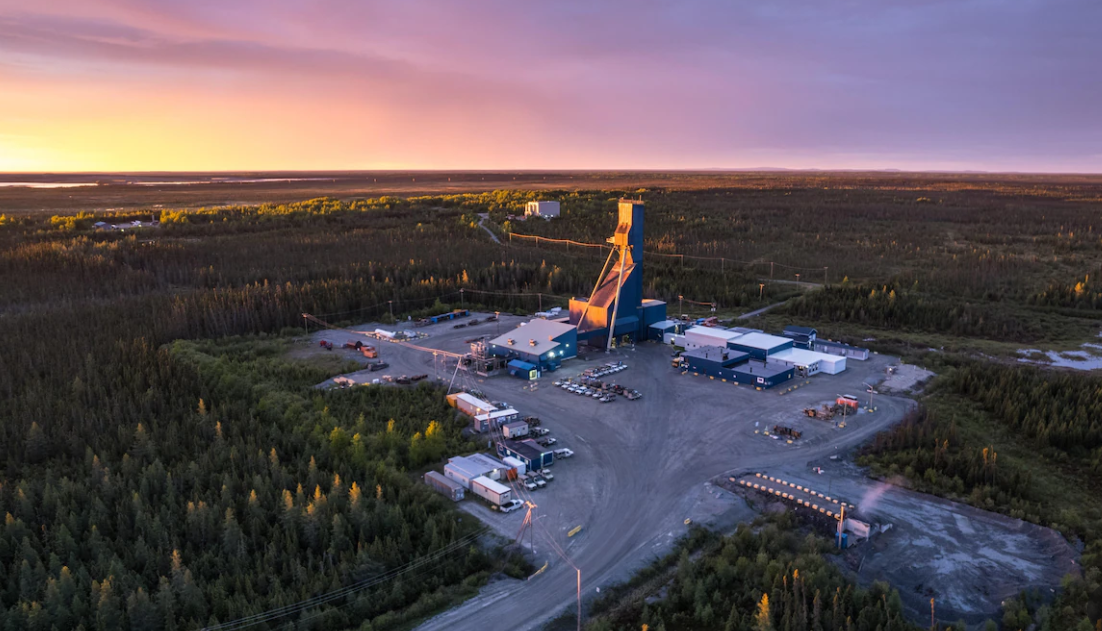
West Red Lake Gold Mines (WRLG) restarted its Madsen gold mine in Ontario earlier this year, achieving commercial production in January following two years of drilling, underground development and infrastructure investment to strengthen its mine plan, Jax Jacobsen reported for CIM Magazine. The company is developing multiple mining areas and refurbishing the site’s shaft to increase hoisting capacity. WRLG also plans to develop satellite deposits, starting with the nearby Rowan project, which could supply the Madsen mill beginning in 2029.
That’s all for this week. If you’ve got feedback, you can always reach us at editor@cim.org. If you’ve got something to add, why not join the conversation on our Facebook, Twitter, LinkedIn or Instagram pages?