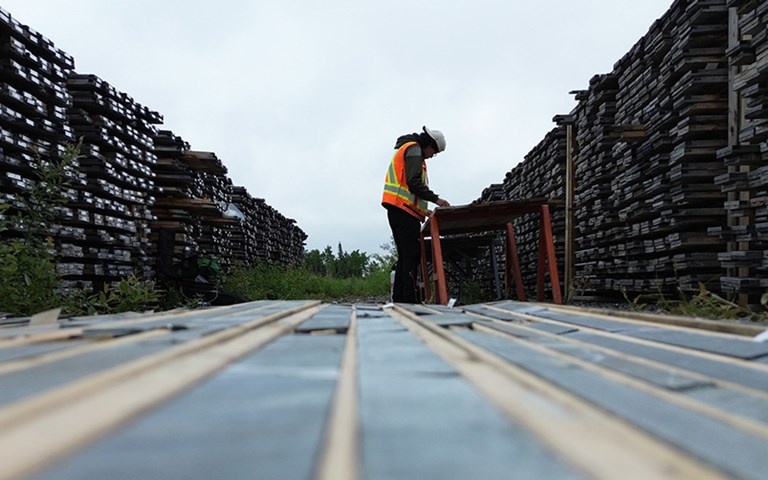
Laurentian University master’s student Stephen Tan examining core from the Kinross Great Bear deposit, summer 2025. Courtesy of Jack Simmons, Laurentian University
If the roughly four million metres of drill core samples sitting in storage across five provinces were laid out horizontally end-to-end, the cylinders of rock, sediment or soil could almost span all of Canada.
That number is a conservative estimate put together using published provincial data by Creative Destruction Lab, an arm of the University of Toronto that supports science and technology start-ups. The true figure is likely much higher.
But these treasure troves of information—and their data—which are used to help mining companies better plan drilling operations, are dispersed in storage across provinces and territories. There is no centralized, digital database of drill core samples in Canada.
The Canadian Digital Core Library (CDCL) plans to change that. The new initiative aims to digitize national core sample data in a public database, and Natural Resources Canada has pledged $40 million over two years from 2026 to 2027 to make it happen.
Minister of Energy and Natural Resources Tim Hodgson announced the initiative at the 2026 PDAC Convention on March 2 alongside the signing of a non-binding declaration of intent between the federal government, Creative Destruction Lab, Laurentian University and mining companies Agnico Eagle, Anglo American, BHP, Hudbay Minerals Inc., Teck Resources Ltd. and Vale.
The hope is that a centralized, public library of mining drill core data will accelerate the discovery of critical minerals deposits as well as strengthen supply chains, attract investment, create jobs and “reinforce Canada’s position as a global leader in clean, responsible and innovation-driven mining,” according to a March 2 press release from Natural Resources Canada.
The public-private-academia collaboration will benefit Canada and the mining industry overall, said Sonia Sennik, CEO of Creative Destruction Lab.
As the CDCL project is still in its early stages, details—including timelines and where the core samples will be sourced from—have not yet been determined. The focus right now is to explore the library design and which data should be included.
While the project specifics are still being ironed out, the collaboration signals an intent to share ideas, concepts and best practices to help build a dataset that supports economic development in Canada, Sennik said.
“This is truly one of those projects where the whole is greater than the sum of its parts,” she added.
The strength of the collaboration will also give Canada “a real, competitive advantage in the area of mineral exploration” by combining expertise from universities, mining companies and those with the digitizing tools to create the library, said Stuart McCracken, vice-president, exploration at Teck.
Drill core samples currently sitting in storage hold untapped potential for advancements in the country’s mining sector, according to Gisele Roberts, director of research and innovation at Laurentian University.
The core samples already exist; the library will just make the information more accessible to the public. Some data from provinces is available now in various forms but is not centralized or standardized.
“You have this core that’s scattered across the country in these core sheds,” said Roberts. “By digitizing it, you’re providing access to the industry and [it is] important from a research perspective.”
While the CDCL will be the first national database of drill core samples, the Northwest Territories has had a head start on digitization. A pilot project to reexamine historical drill core samples was launched by the federal and N.W.T. governments in July 2025 with the goal of pinpointing high-potential critical minerals zones within the Slave Geological Province; particularly lithium, copper, cobalt and rare earth elements (REEs). The data from this initiative will contribute to the CDCL.
Information for exploration
The benefits of the library are expected to ripple out to every corner of Canada’s mining industry, from the academic level to the global stage.
A centralized database of core sample data like the CDCL is a key step to using artificial intelligence (AI) to speed up the discovery of new deposits, Sennik explained. Before the industry can fully benefit from AI to advance mineral exploration, it needs a high-quality dataset to work from.
“There’s a real enthusiasm and excitement about the potential of AI,” she said. “But in order to fully use AI, you really need data. It all starts with the dataset.”
The data will also be a “big benefit” when training the next generation of mining professionals, said Roberts. “Not just for the value it will add to a student’s education, but for the opportunity it creates for graduate students to engage in meaningful, data-driven research and develop new insights.”
Tim O’Connor, vice-president of exploration at BHP, pointed to the country’s excellent geoscience programs, training and industry research, adding “What Canada is incredibly rich in is capability.”
The race for critical minerals
In Canada, 34 minerals are classified as critical for their role in spurring the country’s economic growth and for their use in low-carbon technologies, like electric vehicle batteries or hydrogen fuel cells.
Of that list, cobalt, lithium, graphite, nickel, copper and REEs have been pinpointed as a top priority by the federal government for their potential to fuel domestic manufacturing, and were the focus of initial federal investments, according to the Canadian Critical Minerals Strategy released in 2022.
Demand for some REEs has doubled since 2015 and is expected to expand by an additional one third from 2024 to 2030 thanks to the growth of electrification and new energy technologies, according to a report published in April 2026 from the International Energy Agency.
As the world races to unearth new critical minerals deposits at a pace that can meet the demand, deposits are also harder to find than ever before, O’Connor explained. At the same time, less money is being spent on mineral exploration because fewer deposits are being found.
“Everything we haven’t found is going to require new ideas because it’s more difficult than what has been found in the past,” he said. “What that means is that there is no better place to try new things and to be innovative than in the process of discovery.”
Examining drill core digitally may help geologists to understand the geology of an area, which could fill the gaps where there are no data available, and guide where to look for new deposits, he said.
O’Connor also noted the indirect benefits that could come from a digital core library, including eliminating the cost of acquiring large datasets, increased productivity and social or environmental benefits.
“This is a way of driving sustainability if it helps us realize where we don’t need to [explore] as much as where we could go,” he said. “When it comes to knowledge, there really is no downside.”
Speeding up the discovery process will also have big financial benefits, said Teck’s McCracken.
Discovering new ore bodies can take years, he said. But the digital library will make it possible to pass information from one generation of miners to the next, and remove the need for costly re-drilling.
McCracken has experienced the value of this kind of library and collaboration first-hand from his time working in Australia. Australia’s National Virtual Core Library calls itself the largest digital drill core database in the world, making over 1.6 million metres of drill core data available online to users for free.
Challenges in digitization
Canada has not previously created a national, digitized database of core samples for several reasons—including that it is a pretty monumental undertaking.
Because every province and territory has its own repository of drill core samples, the library will have to coordinate between regions to bring one set of best practices to every part of the country.
The work will also be very labour intensive, with each sample having to be cleaned and scanned individually, Roberts explained.
Deciding on scanning tools is another important step that will impact the project’s costs and timelines, McCracken said.
Different tools can capture different properties, including high resolution photos showing texture or imaging that collects detailed information like mineral type, distribution magnetics or density. The results could generate terabytes of data.
But beyond the physical challenges, a digitization project of this scope also had to wait for technology to catch up.
Common standards for the data have to be developed, Sennik explained. And not just standards for right now, but that work for the needs of tomorrow.
“That is something to be really thoughtful about in how you specify and design [the dataset],” she said.
The platform where the data will live has to be shaped with future-proofing in mind so that, as new technologies, ideas and innovations emerge, the data are usable.
“How do you avoid cornering yourself from a technological standpoint?” Sennik posited. “You want to make sure [the platform] is flexible.”
The library sits at the intersection of emerging technology and the resource industry, according to Sennik—and that is a place with “incredible potential.”
“There are so many advances we can make by carefully synthesizing these two industries,” she said. “This is an opportunity to help build the future of Canada’s minerals industry.”