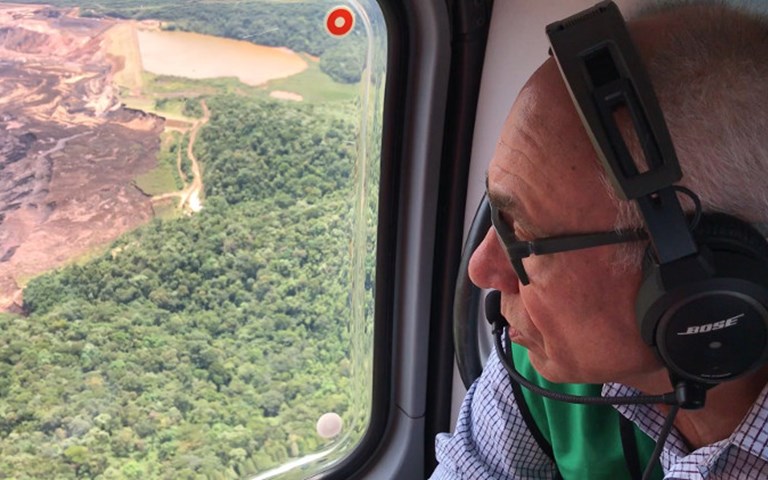
Vale CEO Fabio Schvartsman flew over the site of the Córrego de Feijão tailings dam collapse on the weekend. Courtesy of Vale
(Like what you’re reading? Get our news recap delivered straight to your inbox each Friday.)
Welcome back to your Friday mining news recap. The death toll from Vale’s Córrego de Feijão tailings dam collapse neared 100 on Thursday, and the consequences are piling up.
Dead, missing and rescued: As of Thursday, Vale had reported 99 fatalities, 259 missing and 192 rescued. Vale has vowed to compensate the families of the victims with 100,000 reis (about $36,000) each but, as Reuters reported, that promise has not been well received
From the CEO: “I am completely torn apart by what has happened,” Vale CEO Fabio Schvartsman said on Sunday at a Rio de Janeiro press conference.
Production cuts: The company is temporarily closing some of its Brazilian operations, cutting its iron ore production in Brazil by 40 million tonnes annually, as part of its plan to decommission its 10 upstream tailings dams in the country. Vale will invest 5 billion reis (about $1.8 billion) in the decommissioning process. The iron ore spot price has spiked as a result, currently sitting around US$85 per tonne. CRU Group director Paul Robinson said in a CRU-Fitch Ratings webcast on Friday morning that the open question is what level and grade of replacement production Vale is able to achieve at its other operations, and whether other iron ore operators like Rio Tinto can increase their own production levels.
Arrests and lawsuits: Brazilian authorities issued five arrest warrants on Tuesday for three Vale employees and two contractors. The company said in a statement it was “fully cooperating” with the authorities. Brazil’s Ministry of Labour has filed a public civil action against the company and been granted a preliminary injunction that involved freezing 1.6 billion reis (about $0.6 billion) from Vale’s bank account. In the United States, a securities class action was filed against Vale, CEO Schvartsman and CFO Luciano Siani Pires, alleging the company made “false and misleading statements” and failed to disclose the risk of a dam breach at Córrego de Feijão and what the potential damage could be. “Vale intends to defend vigorously against the claims,” the company said.
Penalties and investigations: Vale has been hit by an ongoing string of court-mandated asset holds, including by the Minas Gerais state labour court and judges in Belo Horizonte and Brumadinho. The company has also been fined by Brazil’s federal environment institute, Ibama, and by the state of Minas Gerais. The country’s securities and exchange commission is investigating whether the company released information related to the dam burst as quickly as it should have. UN human rights experts have called for an investigation into the collapse.
*****
Here’s the rest of your recap.
The federal government is investing $4.2 million in renewable energy projects at Glencore’s Raglan nickel mine and TMAC Resources’ Hope Bay gold mine, both managed by Tugliq Energy Corporation, to reduce diesel reliance at northern mines. The funding, which comes from Natural Resources Canada’s Energy Innovation Program, was announced at the AME’s Roundup conference in Vancouver. Also at Roundup, B.C. Premier John Horgan announced that two provincial mineral exploration tax credits would become permanent rather than renewed annually.
In the gold mergers department, the Globe and Mail reported that Goldcorp CEO David Garofalo will depart the company after its acquisition by Newmont concludes. As well, the Financial Post has a good piece on why bigger is looking better for many gold producers right now. With companies struggling to raise equity in public markets and the rise of passive investment, companies need scale to get attention.
Iamgold said on Monday it would halt construction at its Côté gold project in Ontario until it saw improved market conditions. The company will continue engineering and permitting work at the project, and CEO Steve Letwin said Iamgold still believes in Côté’s potential to “positively transform the company.” On Monday, gold closed at about US$1,300/ounce. This summer the precious metal dropped to around US$1,200/ounce from about $1,350/ounce at the beginning of the year. On Wednesday, the company reported Indicated Resources of 744,000 ounces of gold with an average grade of 1.28 grams per tonne and an Inferred Resource of 23.2 million tonnes with an average grade of 1.58 g/t at its Diakha – Siribaya gold project in western Mali.
The Canadian Mineral Processors Society gave out its 2019 awards at its annual conference last week in Ottawa. Michel Bourassa, Scott Martin, Wesley Griffith and Paul Fournier were recognized for their contributions to CMP and the mineral processing industry. University students Nicholas Seniuk and Nabil Khan received the society’s two memorial scholarships, and Roger Lin, Martin Dionne, Alexandra Bouchard and Evan Houlding were awarded for their work in the Lucky Amaratunga Technical Report Competition.
A fire at Nemaska Lithium’s Nemiscau, Quebec worksite caused major damage to the cafeteria on Wednesday night. No workers were harmed by the blaze, and work on Whabouchi, which had been suspended in its wake, is scheduled to resume on Feb. 5.
Energy companies cannot escape their responsibility to clean up old oil wells in the event of bankruptcy, the Supreme Court ruled on Thursday. The 5-2 decision, which says that cleanup and remediation work must come before a bankrupt company’s creditors can be paid, overturned two lower court rulings that sided with the trustee of Alberta junior oil and gas producer, Redwater Energy Limited.
The federal government may have overpaid for the Trans Mountain expansion project by up to $1 billion, according to a new report from the Parliamentary Budget Office. The report said the government was the only known bidder on the project, and parliamentary budget officer Yves Giroux likened the purchase to buying a car without trying to haggle on the price.