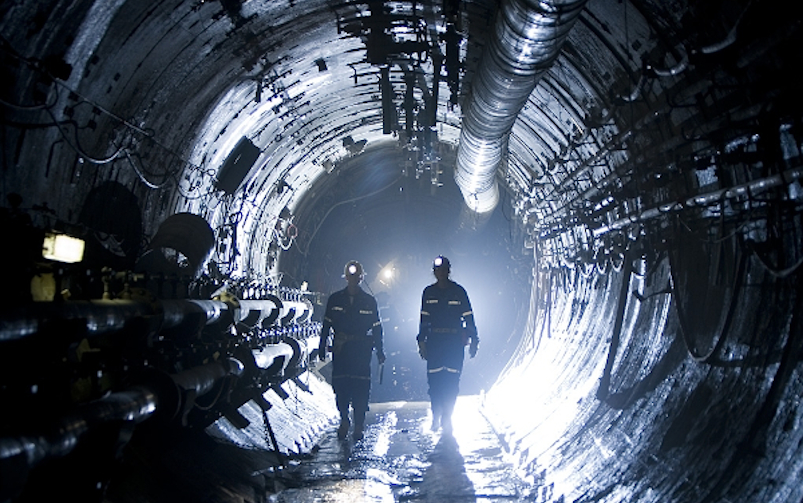
Agnico Eagle's Pinos Altos mine in Mexico was awarded the TSM Environmental Excellence Award for its initiative promoting soil regeneration. Courtesy of Agnico Eagle.
(Like what you’re reading? Get our weekly recap delivered straight to your inbox each Friday.)
Welcome back to your weekly mining news recap, where we catch you up on some of the news you may have missed. This week’s headlines include Artemis Gold acquiring New Gold’s Blackwater project, BHP halting extension plans to avoid damaging Aboriginal heritage sites and NORCAT receiving funding to develop a new training and education program for Canadian miners.
Zijin Mining will purchase Guyana Goldfields for $323 million in cash, or $1.85 per share, ending a weeks-long bidding war for the company. The final deal represents a 35 per cent premium over the previous acquisition bid by Silvercorp Metals, which declined to match Zijin Mining’s bid to acquire Guyana Goldfields. Per the deal, the Chinese state-owned miner will also provide the company with a US$30 million secured-loan facility for its flagship Aurora gold mine. The deal will be voted on by shareholders at Guyana Goldfields’ annual and special meeting at the end of July.
Artemis Gold has signed a $190 million asset purchase agreement to buy New Gold’s Blackwater gold project in central British Columbia. Once the acquisition is complete, Artemis Gold will pay New Gold $140 million in cash and make a second payment of $50 million one year after closing in addition to transferring $20 million or 9.9 per cent, whichever is less at the time of closing, of its shares to New Gold. The proposed mine is estimated to produce 7 million ounces of gold and 30 million ounces of silver over a 16-year mine life. The company intends to focus on completing project financing, meeting permit requirements and conducting a new pre-feasibility study for the $1.9 billion project.
Lumina Gold has released the results of its preliminary economic assessment for its flagship Cangrejos project in Ecuador which the company said includes a number of improvements over a 2018 assessment. The new assessment has an increased mineral resource definition, a revised process flow sheet and the addition of the Gran Bestia deposit. It estimates annual production of 366,000 ounces of gold over a 25-year mine life, a seven year increase from the 2018 assessment. The new evaluation adds US$169 million to the initial capital costs of the project and another US$600 million of net present value. A process plant expansion planned to be commissioned in the mine’s sixth year would cost an additional US$454 million.
Eldorado Gold has announced it is preparing to construct a US$24-million decline at its Lamaque underground mine in Val-d’Or, Quebec. The three-kilometre tunnel will connect the company’s Sigma mill to the 405-metre level of the Triangle mine, allowing for easier exploration in the area and eliminating re-handling and hauling of ore at the mine’s surface. Construction on the incline is scheduled to begin in the third quarter of 2020 and be completed in the first half of 2022.
BHP has suspended plans to expand its South Flank mine in Western Australia, which would destroy dozens of Aboriginal heritage sites, as reported by the BBC. The company received government approval to work on up to 40 sites as part of its mine expansion, but announced it would be conducting further consultations with local Aboriginal groups following the suspension. The announcement comes following Rio Tinto’s destruction of two 46,000-year old indigenous caves in Western Australia in May which sparked public outcry and calls for reforming heritage protection laws.
Miners are beginning to look at hydrogen, which is still a niche energy resource in industrial operations, as an alternative to power operations. Companies such as Agnico Eagle and Glencore are beginning to trial hydrogen power and draft safety and best practices standards for the hydrogen usage in equipment and operations. While the operational changes needed to adopt hydrogen power may be intimidating, the drive away from diesel and cut down on emissions may be what brings hydrogen to mainstream mining.
In a paper published recently in CIM Journal, a team of researchers confirmed that efficiency in grinding mills has not really improved in decades. Adjusting particle sizes, locating optimum operating points and hiring people who understand control systems are a couple steps that operations can take to save energy. Jocelyn Bouchard, an associate professor of chemical engineering at Université Laval and lead author of the paper, discusses how mineral processing operations can implement process controls to save energy and improve efficiency.
NORCAT has received a $1.3 million investment from Future Skills Centre to develop an interactive and experiential blended training and learning program for Canada’s mining industry. These programs will include different learning models such as eLearning, virtual reality and equipment training and will train miners on operational safety, efficiency and productivity for two weeks on each piece of mining equipment. NORCAT has partnered with companies such as Vale, Technica Mining and Glencore’s Sudbury Integrated Nickel Operations to create the programs over the next 18 months.
Great Bear Resources has released further promising results from the ongoing exploration program at its flagship Dixie gold project in Ontario. The company’s drilling campaign is exploring a five-km long by 500-metre deep grid at the project south of Red Lake. Among the results from 115 drill holes was one hole that included 576 grams per tonne over one metre within a further interval of 31.33 grams per tonnes of gold over 20.55 metres. Last month, Great Bear Resources was recognized with the A.O. Dufresne Exploration Achievement Award for its work at the Dixie project. The drilling is part of the company’s $21-million exploration program at the property.
And finally this week, Agnico Eagle’s work on soil regeneration at its Pino Altos mine in Mexico earned the Mining Association of Canada Towards Sustainable Mining award for environmental excellence, while Cameco’s Community Based Environmental Monitoring Program earned the prize for excellence in community engagement. The TSM program emphasizes practicing sustainable mining operations which are socially, economically and environmentally responsible.
If you’ve got feedback, you can always reach us at editor@cim.org. If you’ve got something to add, why not join the conversation at our Facebook, Twitter or LinkedIn pages? Like your recap with a few more gifs? Check out our mining news recap stories on our Instagram.
Remember to stay safe, keep your distance and wash your hands!