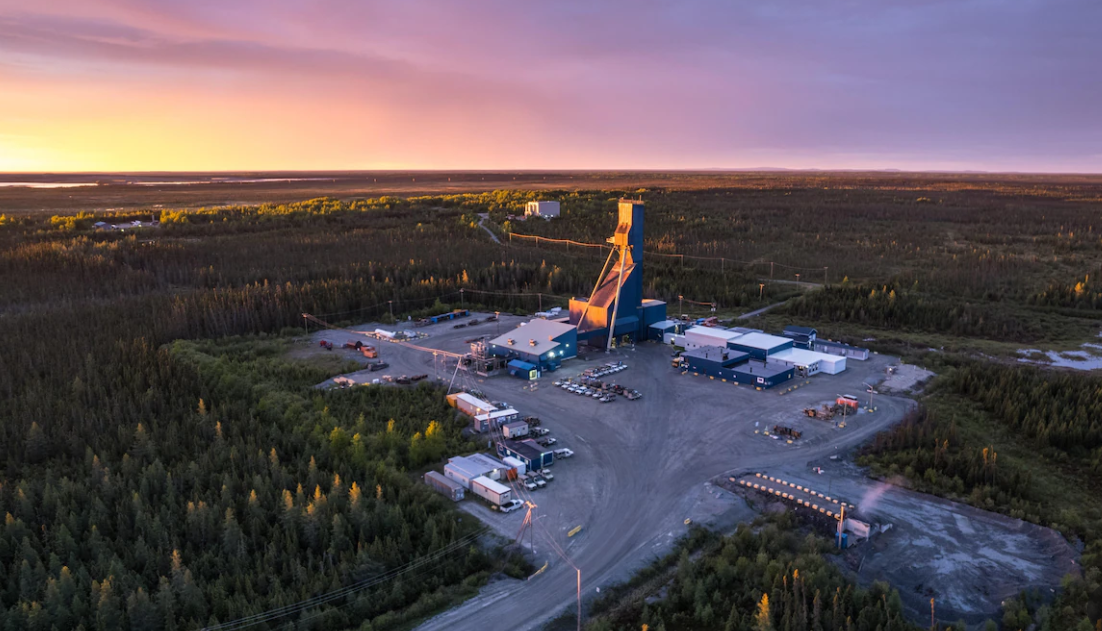
Teck’s Trail operations in British Columbia is currently Canada’s sole producer of germanium and North America’s largest producer of the critical mineral. Courtesy of Teck Resources Limited.
Welcome back to your weekly mining news recap, where we catch you up on some of the news you may have missed. This week’s headlines include two Canadian mining technology companies receiving federal funding, Global Battery Materials advancing its Kearney graphite project in Ontario and New Brunswick moving to revive the Lake George antimony mine.
Canada will provide up to $400 million through the Canada Growth Fund to support Teck Resources Limited’s planned expansion of its Trail smelter and refinery complex in British Columbia. The expansion, part of a potential $850 million investment by Teck, is expected to double germanium and antimony production capacity at the site while adding gallium processing capability. The agreement serves as the first investment under the Canada Critical Minerals Accelerator program, introduced in Budget 2025.
On Monday, Ontario and Alberta announced the proposed route for the 3,300-kilometre Northern Shield Energy Corridor, a crude oil pipeline that would connect Hardisty, Alberta, to Sarnia, Ontario. The project would transport around 500,000 barrels of oil daily, with potential to grow to 800,000 barrels per day. A feasibility study for the project is expected by the end of the year. This follows last week’s announcement of a proposed pipeline route to the coast of British Columbia.
Emissions Reduction Alberta has committed $37 million to 10 projects advancing next-generation drilling technologies as part of its Drilling Technology Challenge. Among the funded projects is Eavor Technologies’ Eavor-Loop geothermal technology, which received $8 million. The underground closed-loop technology uses the Earth’s natural heat to generate low-emission energy, with the potential to supply heat and electricity to remote mining operations.
On Thursday, the federal government announced funding for two mining technology companies. Novamera will receive $3.8 million to support the continued development of its directional drilling mining technology at the Cam copper project near Kirkland Lake. The genomics company Koonkie will get $2.89 million to advance its AI-powered environmental monitoring platform.
Global Battery Materials has released a preliminary economic assessment (PEA) for its Kearney graphite project in Ontario. The assessment outlined a brownfield mine redevelopment with an initial 20-year mine life, requiring around $65.9 million in initial capital investment. With the PEA complete, the company is now advancing towards a definitive feasibility study.
The New Brunswick provincial government has chosen Avenir Minerals, a subsidiary of Agnico Eagle Mines, to negotiate an agreement for exploration of the former Lake George antimony mine site, The Canadian Press reported. The move supports the province’s efforts to revive its mining sector and comes amid renewed interest in securing supplies of antimony, which is listed as a critical mineral by Canada, the United States and the European Union amid concerns over global supply concentration in China.
Galleon Gold has awarded Aki-Dumas Limited Partnership an early contract to begin preparatory underground development at the West Cache gold project near Timmins, Ontario, Canadian Mining Journal reported. The work will create access to a bulk sample area and install key underground infrastructure. A 2022 PEA for the project outlined an initial capital expenditure of approximately $150 million, with average annual gold production of about 85,500 ounces over an 11-year mine life, along with a two-year ramp-up period.
A recent report from PricewaterhouseCoopers highlighted Canada’s advantage in critical minerals but warned that resources alone are not enough. As demand for these minerals grows, the report argued that Canada must make projects more investable through supportive permitting and regulatory frameworks, greater capital investment, expanded processing capacity and broader adoption of new technologies to turn mineral potential into operating mines and processing projects.
Earlier this year, the Royal Bank of Canada announced a new Indigenous advisory and finance practice to help Indigenous groups access capital and participate as equity owners in major projects, Kelsey Rolfe reported for CIM Magazine. The initiative combines advisory services, capital markets expertise and relationship banking support to help Indigenous communities pursue ownership opportunities in mining, energy and infrastructure. It comes as governments and lenders expand loan guarantee programs to reduce barriers to Indigenous participation in major projects.
That’s all for this week. If you’ve got feedback, you can always reach us at editor@cim.org. If you’ve got something to add, why not join the conversation on our Facebook, Twitter, LinkedIn or Instagram pages?