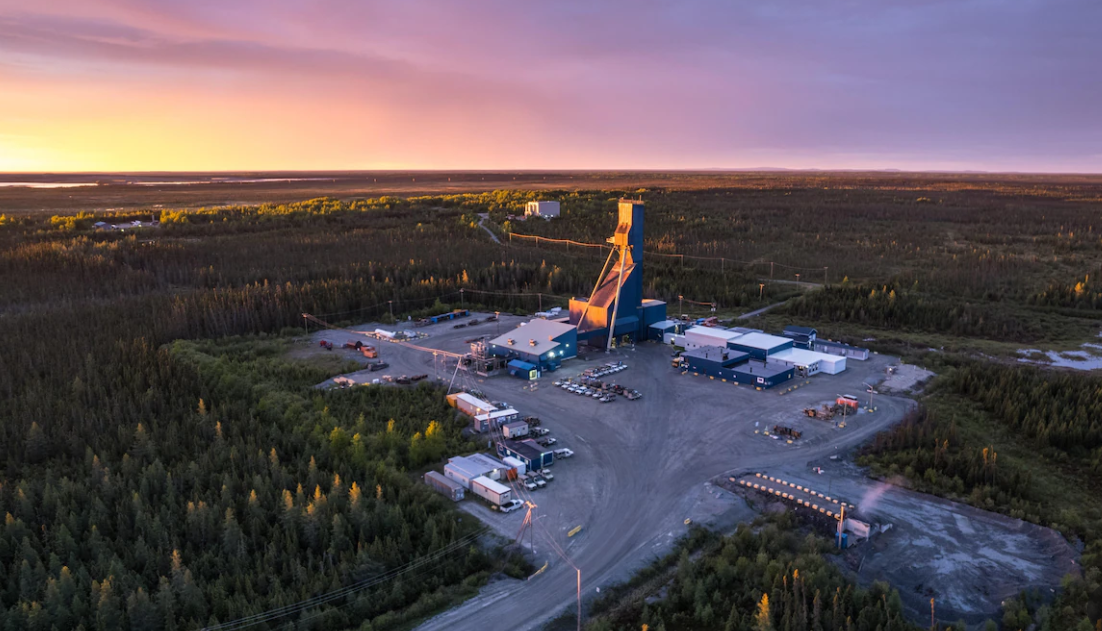
The community of Churchill Falls, Labrador, is home to the Churchill Falls Generating Station. This week, Ottawa announced $10 billion in funding for a broader clean energy expansion that includes upgrades to the station. Courtesy of Newfoundland and Labrador Hydro.
Welcome back to your weekly mining news recap, where we catch you up on some of the news you may have missed. This week’s headlines include steel and aluminum tariffs taking centre stage in Canada-U.S. trade talks, a B.C. First Nation pulling support for Seabridge Gold’s KSM project and federal scrutiny of a Lithium Chile deal.
NexGen Energy has begun the construction of its $2.2-billion Rook I uranium mine in northern Saskatchewan, CBC News reported. The underground mine is expected to operate for 24 years and produce up to 30 million pounds of uranium annually. First production is targeted for 2030.
The Canadian federal government announced on Monday that it will provide $10 billion in financing towards a roughly $70-billion clean energy expansion in Labrador. The expansion includes upgrades at the Churchill Falls generating station, development of the Gull Island hydroelectricity project and new transmission lines. The government also referred the Labrador Trough Clean Power, Critical Minerals and Infrastructure Corridor to the Major Projects Office to advance related mining and infrastructure development.
Laurentian University will receive up to $1 million from Creative Destruction Lab for a two-year research program supporting the Canadian Digital Core Library. A dedicated research program at Laurentian’s Harquail School of Earth Sciences will examine the scope and value of the library’s data and test potential uses for AI and machine learning. The federally backed initiative aims to scan and digitize drill core samples from across Canada and create a database to improve mineral exploration, while Laurentian’s research program will also provide training opportunities for graduate students and postdoctoral fellows.
Trade negotiations between Canada and the United States continued today, with a reduction in the 50 per cent tariff on Canadian steel and aluminum among the key terms being discussed. On Tuesday, U.S. president Donald Trump said a deal between the two countries had been struck to avoid the addition of further tariffs on Canadian goods, however the details surrounding it have been limited.
The Gitxsan Huwilp Government withdrew its support for Seabridge Gold’s KSM copper-gold project in British Columbia on Wednesday. The government is backing the Tsetsaut Skii km Lax Ha (TSKLH) Nation’s call for stronger consultation over environmental concerns, including the project’s proposed tailings facility. The move follows a B.C. Supreme Court ruling in June that overturned the province’s 2024 “substantially started” determination after finding the province’s consultation with TSKLH to be inadequate, requiring the province to reconsider the decision following further engagement. Seabridge says it supports the court-ordered consultation process and is committed to meaningful collaboration with TSKLH.
A US$175-million deal to sell Lithium Chile’s Argentine subsidiary, Argentum Lithium, to China Union Holdings has drawn scrutiny from Canadian officials, Mining.com reported. Ottawa has flagged possible national security risks, although Toronto Venture Exchange-listed Lithium Chile argues that the transaction falls outside Canadian jurisdiction because its subsidiary has no presence in Canada. Shareholders have backed the sale, which includes Lithium Chile’s interest in the Salar de Arizaro lithium project in Argentina, but approval from Chinese regulators is still pending.
Algoma Steel suspended steelmaking operations at its electric arc furnace in Sault Ste. Marie, Ontario, on Monday after a turbine unit at its Lake Superior Power facility was removed from service, Reuters reported. The company said an abnormality prompted the unplanned shutdown, which could affect future shipments and could last up to 21 days, though alternative power could enable a restart late next week.
AngloGold Ashanti is investing $58.5 million in Thesis Gold & Silver, increasing its stake in the company from five per cent to 9.7 per cent, The Northern Miner reported. The funding will support exploration, technical studies and development of the Lawyers-Ranch gold-silver project in northern British Columbia. Thesis is targeting a feasibility study for the project in 2027.
Vancouver-based Ideon Technologies is joining an international research consortium to attempt the world’s first high-resolution muon imaging experiment powered by a compact laser-plasma accelerator. The experiments at Romania’s ELI-NP facility will generate directed beams of muons—subatomic particles that can penetrate dense materials—for Ideon’s customized detectors. Simulations suggest the approach could sharply reduce imaging times compared with naturally occurring cosmic-ray muons, with potential applications in mining, infrastructure and other industries.
Canada’s green steel transition is being slowed by U.S. tariffs, high upfront capital costs and uncertainty about future demand and export markets, Jax Jacobsen reported for CIM Magazine. Still, experts say Canada could benefit from its high-quality iron ore and access to low-carbon electricity by producing low-carbon steel and green iron. Investing in green steel and green iron production now could strengthen domestic supply chains and help prevent Canada from falling behind its global competitors.
That’s all for this week. If you’ve got feedback, you can always reach us at editor@cim.org. If you’ve got something to add, why not join the conversation on our Facebook, Twitter, LinkedIn or Instagram pages?