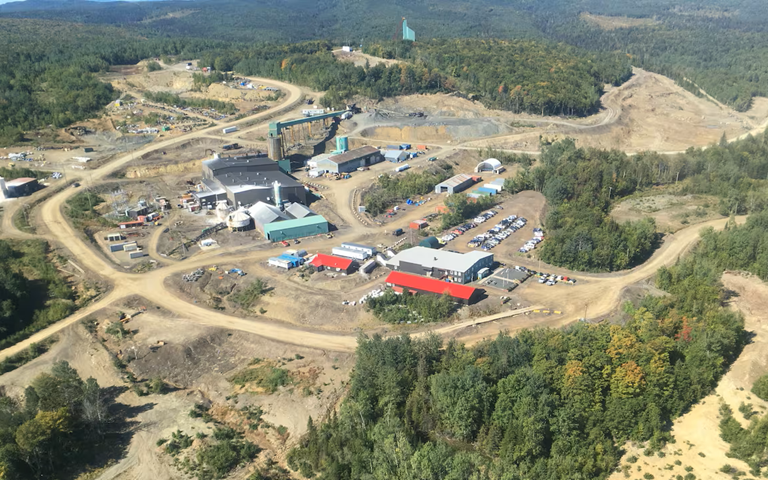
Canadian Copper now owns the shuttered Caribou mine in New Brunswick, formerly owned by Trevali Mining’s New Brunswick division. Courtesy of Trevali Mining.
Welcome back to your weekly mining news recap, where we catch you up on some of the news you may have missed. This week’s headlines include concerns raised that B.C. Premier David Eby’s idea to leverage Canadian critical minerals could escalate trade tensions with the United States, Rock Tech inks a spodumene supply agreement and second quarter results roll in.
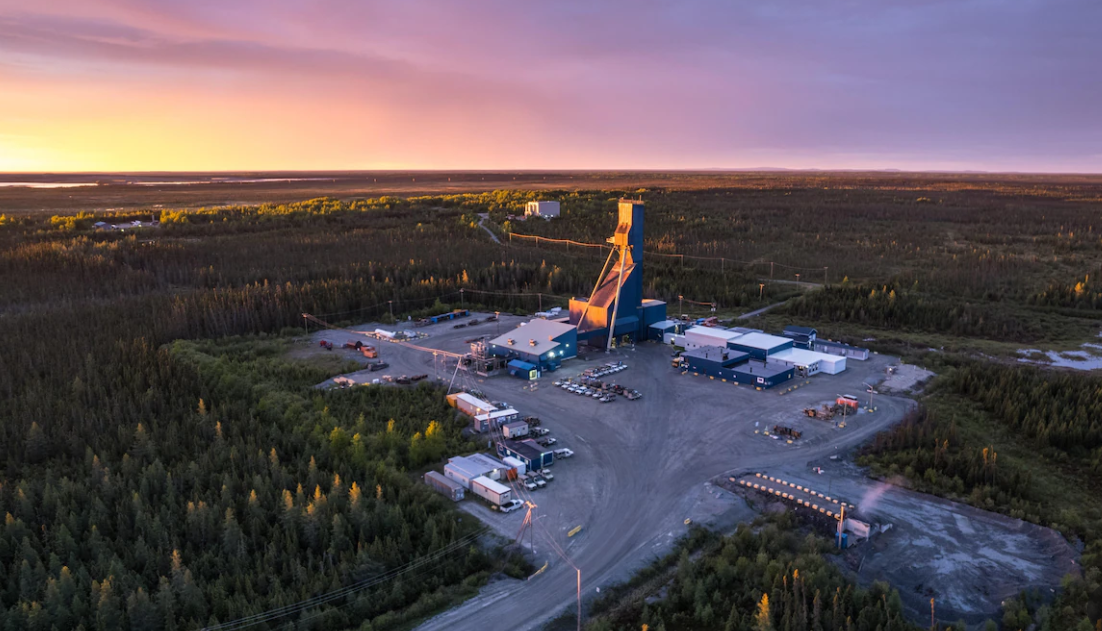
Denison Mines has started full-scale construction of the Phoenix in-situ recovery uranium mine at its Wheeler River site in Saskatchewan, aiming for first production in mid-2028. More than 20 per cent of civil work is finished, with the site’s camp capacity expanded to accommodate nearly 400 workers. The project is expected to produce 56.2 million pounds of triuranium octoxide uranium over an initial mine life of 10 years.
The Quebec government has selected Troilus Mining’s Troilus copper-gold project as one of the first to receive specialized support through its Filon initiative. The program will assign mining experts to projects to improve coordination with government agencies and identify permitting bottlenecks. Troilus submitted an environmental assessment for its project in 2025 and secured a 70-megawatt hydroelectric power allocation from Hydro-Québec last month.
Canadian Copper has acquired the idled Caribou mine in New Brunswick for $6.2 million, CBC News reported. The company plans to restart the Caribou mill and use it to process copper, zinc, silver and lead from its nearby Murray Brook project. Canadian Copper hopes to begin work at Murray Brook in 2027 and start processing material at the Caribou mill in 2028, pending environmental approval. The New Brunswick government took over the Caribou site in 2023 after Trevali Mining’s New Brunswick division entered receivership.
B.C.’s mining sector is warning that Premier David Eby’s suggestion that Canada restrict U.S. access to Canadian critical minerals in response to new tariffs could escalate the trade dispute and disrupt integrated supply chains, The Vancouver Sun reported. Industry members pointed to Teck Resources Limited’s Trail smelter in southern British Columbia, which processes zinc and lead ore from the company’s Red Dog mine in Alaska, as an example of an integrated cross-border supply chain and warned of possible U.S. retaliation.
Rock Tech Lithium has signed a seven-year offtake agreement to supply Transamine with spodumene concentrate from its Georgia Lake project in northern Ontario, Canadian Mining Journal reported. Deliveries are expected to begin at 50,000 dry tonnes in 2028 and rise to 100,000 tonnes annually thereafter. The agreement allows Rock Tech to direct Georgia Lake concentrate to its planned Red Rock converter in Ontario for processing into battery-grade lithium chemicals. If Rock Tech determines that the concentrate is needed for its planned Red Rock converter, the parties could amend the agreement so that Transamine receives battery-grade lithium hydroxide monohydrate and/or lithium carbonate instead of spodumene concentrate.
Some companies shared second quarter financial results this week, including Teck Resources Limited, Endeavour Silver, Kinross Gold, Agnico Eagle Mines, Alamos Gold, Centerra Gold, Cenovus Energy, DPM Metals, First Quantum Minerals, First Majestic Silver, Eldorado Gold, Imperial Oil, Cameco and Hudbay Minerals.
Agnico Eagle Mines will invest $60 million to raise its ownership stake in Cadillac Mines from 9.7 per cent to around 11.1 per cent, The Globe and Mail reported. Cadillac owns several projects in Canada, including the Kerr-Addison gold and Geminid nickel projects in Ontario, along with the Galloway gold project in Quebec.
MacLean Engineering has selected Scania Industrial Batteries as the main battery supplier for its underground electric mining vehicles. MacLean will integrate Scania’s Core 800 battery packs as it redesigns its electric vehicles to improve performance and safety, reduce total cost of ownership and support its goal of achieving net-zero greenhouse gas emissions by 2040.
Mining companies are collecting unprecedented amounts of operational data but often lack the standards and skills needed to manage and interpret this data effectively, Rosalind Stefanac reported for CIM Magazine. Experts warn that siloed systems and unreliable inputs can undermine analytics and artificial intelligence tools. Stronger data governance and workforce training can be beneficial in supporting safer operations and better decision making.
In a Q&A for CIM Magazine with Lynn Greiner, founder Francisca Lombard explained how the MineGPT platform can turn lengthy technical reports into searchable and comparable insights. The AI platform helps users compare costs, grades and resource sizes, identify cross-disciplinary risks and analyze reports faster, with answers grounded in cited in-text references. MineGPT cannot analyze images yet, and does not replace the judgment and accountability of qualified professionals, but planned tiers will add benchmarking tools and multi-disciplinary reviews.
That’s all for this week. If you’ve got feedback, you can always reach us at editor@cim.org. If you’ve got something to add, why not join the conversation on our Facebook, Twitter, LinkedIn or Instagram pages?